Pure gold, at 24 karats, is too soft for jewellery. A 24K gold ring would bend under the pressure of a handshake. At the other end, 14K and 18K alloys, common in Western jewellery, contain enough copper, silver, and zinc to make the metal durable but fundamentally change its character. The colour shifts from gold's natural deep yellow to a paler, sometimes pinkish hue. The warmth disappears.
Kerala's goldsmiths settled on 22 karats not by accident, but through centuries of empirical refinement. At 91.6% pure gold, 22K retains the rich, warm, unmistakably golden colour that is central to the aesthetic of temple jewellery. The remaining 8.4%, typically a blend of silver and copper, provides just enough structural integrity for the intricate nakshi carving and repousse work that defines Kerala's goldsmithing tradition.
The Malleability Advantage
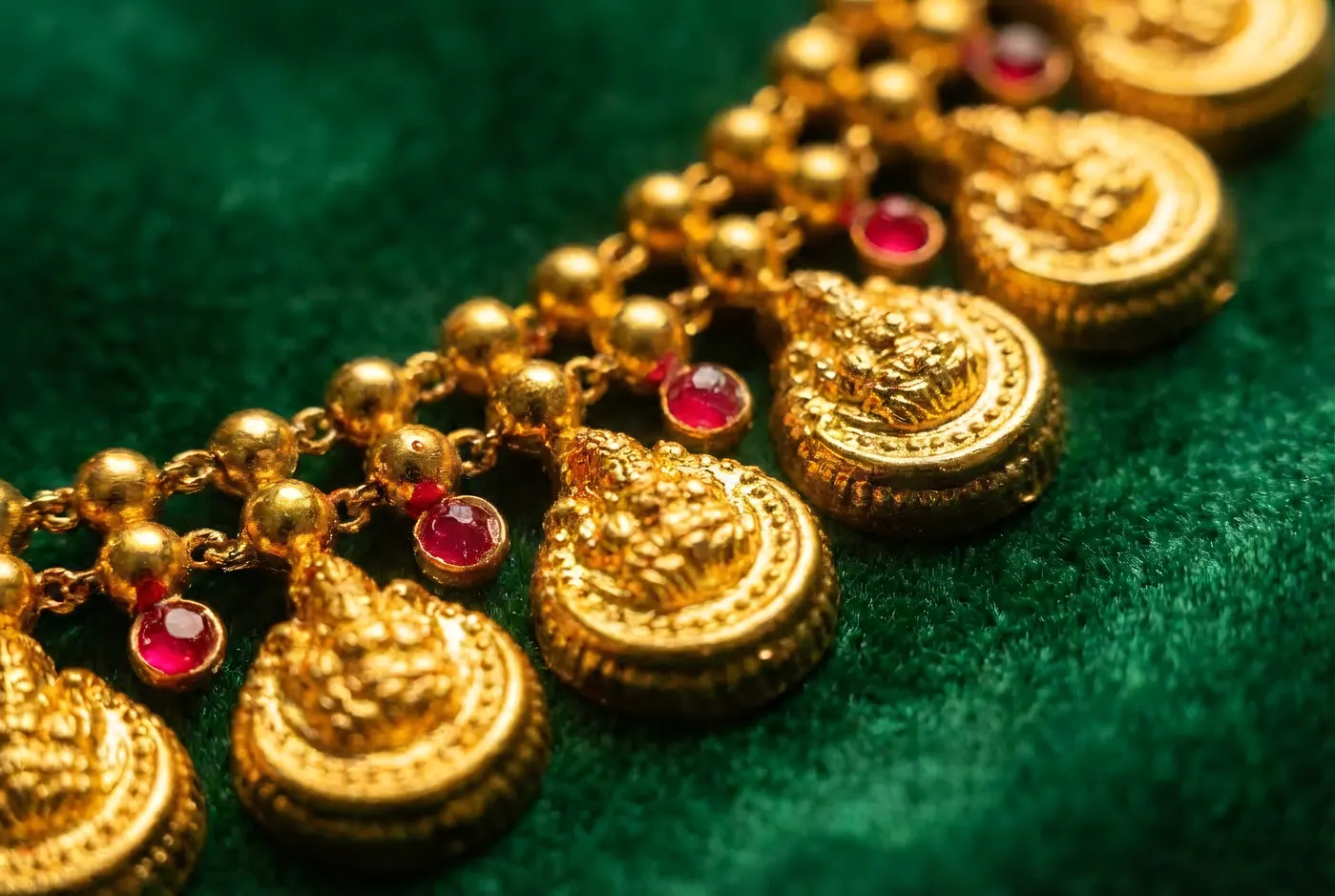
The nakshi technique, in which artisans carve narrative scenes into gold using fine steel tools, requires a metal that yields to the chisel without cracking. 22K gold provides exactly this balance. The artisan can press the image of Lakshmi, her lotus throne, and flanking elephants into a coin no larger than a thumbnail, achieving detail that would be impossible in harder alloys. The gold flows under the tool rather than resisting it.
This same malleability is essential for repousse work, where gold is hammered from the reverse side to create three-dimensional forms. The serpent hoods of a Nagapada Thali, the mango shapes of a Manga Mala, all require a metal that can be pushed into complex curves without tearing. At 18K, the copper content makes the metal too springy. At 22K, it remembers the shape the artisan gives it.
The Colour of Devotion
In Hindu tradition, gold is not simply a precious metal. It is the colour of the sun, of Lakshmi, of divine light itself. The Sanskrit word for gold, "suvarna," means "good colour." This is not metaphorical. Temple jewellery is worn during pujas, weddings, and festivals where it serves a ritual function. The colour of the gold is as important as its weight.
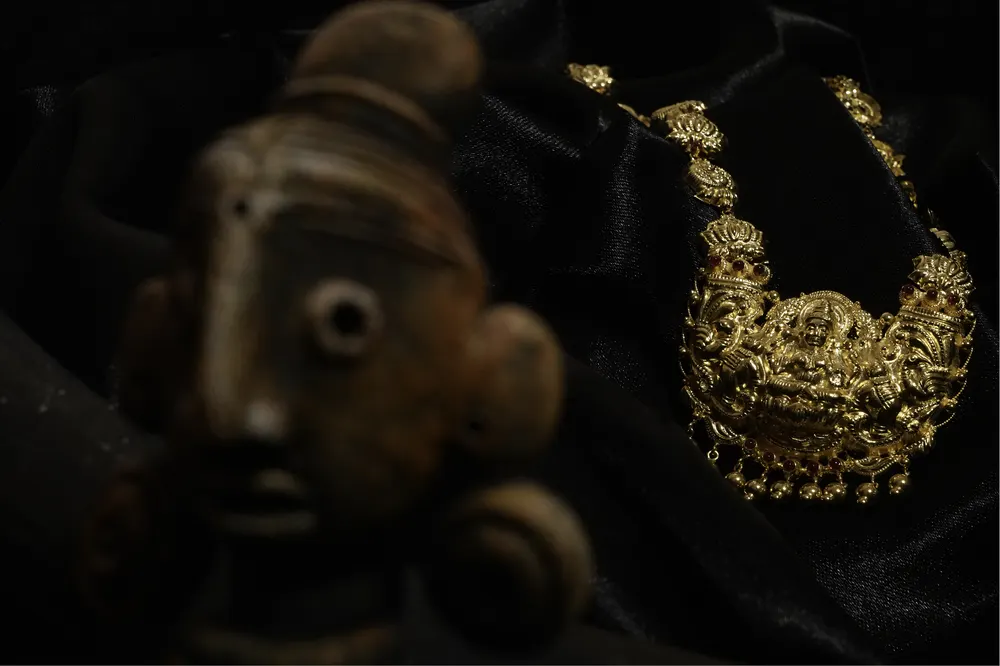
22K gold has a specific warmth that photographs differently from lower karatages. Under oil lamps, which is the traditional lighting of Kerala's temples and wedding halls, 22K gold catches the amber firelight and seems to glow from within. This is not poetic licence. It is physics. The higher gold content means more of the metal's natural spectral reflectance is preserved, particularly in the warm yellow and red wavelengths that dominate incandescent and flame lighting.
The Investment Logic
In Kerala, gold jewellery has historically served as a family's primary store of wealth. Before modern banking reached rural India, a woman's jewellery was her financial security, and in many families, this remains true. A 22K necklace holds more gold value per gram than an 18K piece, making it a more efficient store of wealth. When melted down, which is how jewellery is traditionally recycled in India, the higher purity means less refining loss.
The Kerala gold market operates differently from Western jewellery markets. Prices are quoted per gram of pure gold content, with a making charge added on top. Buyers are acutely aware of karatage because it directly affects the gold value of the piece. A 50-gram necklace in 22K contains 45.8 grams of pure gold. The same weight in 18K contains only 37.5 grams. Over a bridal set that might weigh 200 grams or more, this difference represents a significant sum.
A Material Chosen by Time
22K gold is not a compromise. It is a solution refined over centuries by artisans who understood their material intimately. It is soft enough to carve, warm enough to honour the gods, valuable enough to secure a family's future, and durable enough to pass from grandmother to granddaughter. Every Damini piece is crafted in 22K because this is what temple gold demands. The tradition chose the karatage. We simply honour that choice.
"When you hold a piece of 22-karat temple gold, you are holding something that has been perfected not by a single jeweller, but by centuries of jewellers, each one refining what the last one learned."