In the workshops of Thrissur, there is a word that carries more weight than any other in the goldsmith's vocabulary: nakshi. Derived from the Sanskrit "naksha," meaning drawing or design, nakshi refers to the practice of carving detailed pictorial scenes directly into the surface of gold. It is not engraving in the Western sense, where lines are incised into the metal. Nakshi is closer to sculpture, where the goldsmith raises, shapes, and defines three-dimensional figures from a flat sheet of gold using nothing but hand tools, patience, and a knowledge that has been passed down through families for generations.
The Process
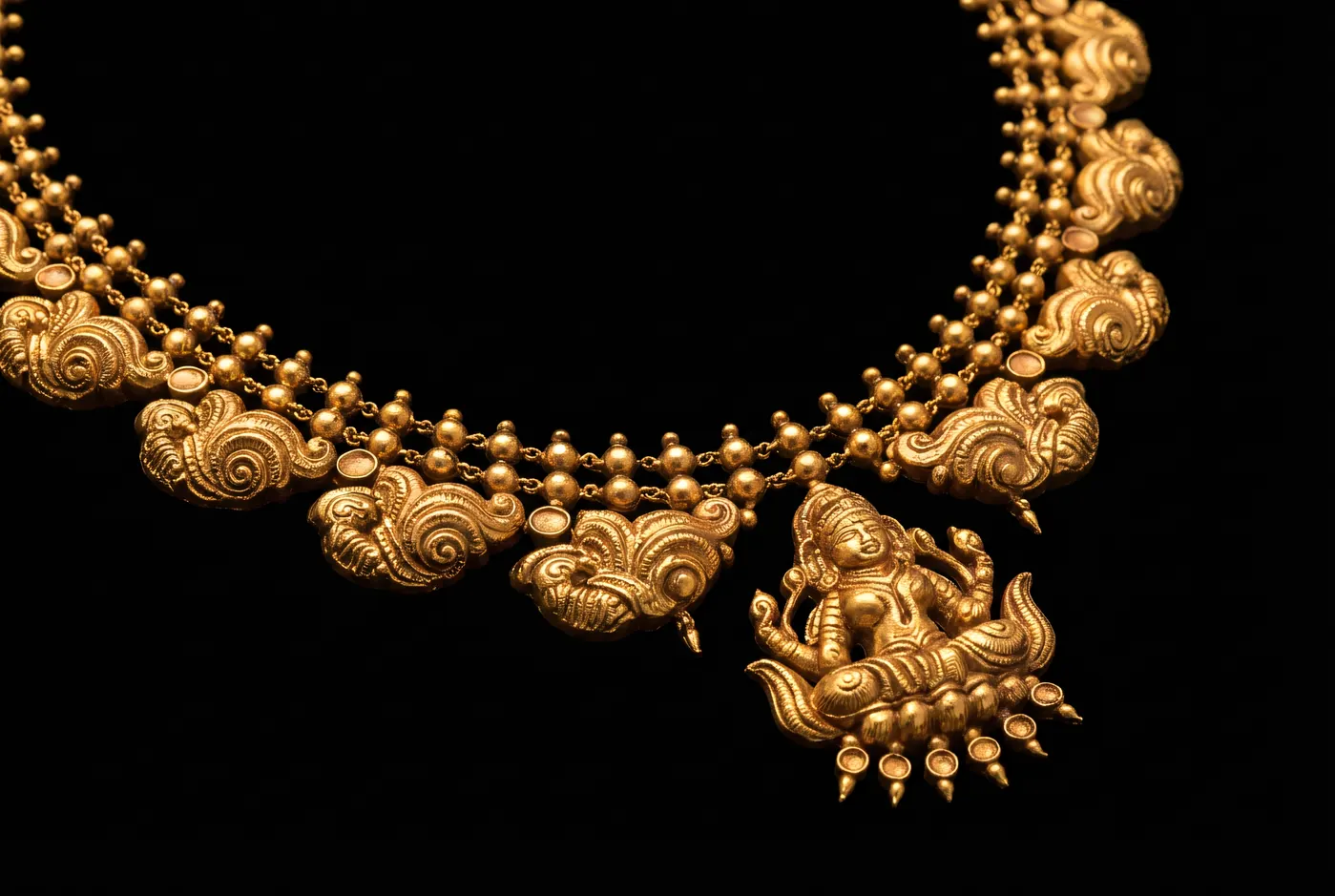
A nakshi pendant begins as a flat disc of 22-karat gold, typically 2 to 3 millimetres thick. The goldsmith first sketches the design onto the gold surface using a fine steel scriber. For a Lakshmi Haar pendant, this sketch will include the goddess seated on her lotus throne, two elephants on either side, a decorative border of scrollwork, and sometimes additional figures from the Hindu pantheon.
The goldsmith then begins the carving process using a set of tools called "uli," small steel chisels with tips ground to various profiles: flat, round, V-shaped, and pointed. The goldsmith holds the uli in one hand and a small hammer in the other, tapping the chisel with controlled force to push the gold into the desired form. The work proceeds from the background forward: first the flat areas are depressed, then the figures are raised, then the details, facial features, jewellery on the deity, individual lotus petals, are refined.
The Scenes
The subjects of nakshi work are drawn almost exclusively from Hindu mythology, and they follow a visual language that has been codified over centuries. The most common scene is Gajalakshmi: Lakshmi seated on a lotus, with two elephants pouring water from their trunks in a gesture of abhishekam (sacred bathing). This image appears on the central pendant of the Lakshmi Haar and has been the defining motif of Kerala temple jewellery for as long as the tradition has existed.
Other common nakshi subjects include Krishna playing the flute (Venugopala), Ganesha seated with his modak (sweet dumpling), the Dashavatara (ten incarnations of Vishnu), and scenes from the Ramayana and Mahabharata. Each scene has specific iconographic rules: Krishna must hold the flute in a particular way, Ganesha's trunk must curve in the correct direction, Lakshmi's lotus must have the right number of petals. These rules are not written in manuals. They live in the goldsmith's hands, absorbed through years of watching and working alongside a master.
The Time It Takes
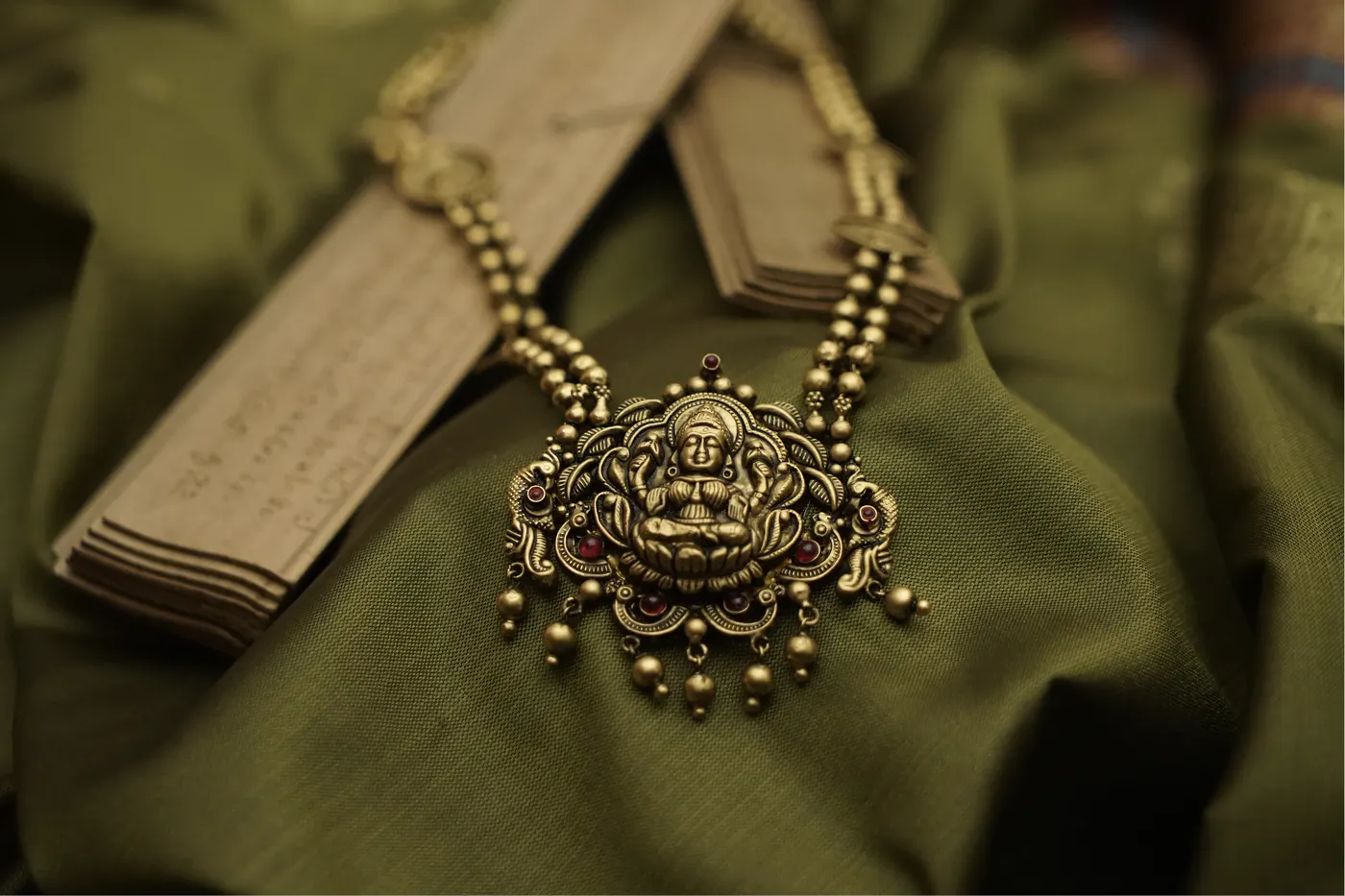
A single nakshi pendant, roughly 3 centimetres in diameter, takes an experienced goldsmith between two and four days to complete. A full Lakshmi Haar with 15 to 20 pendants can require two to three months of carving work alone, before the pendants are assembled, linked, and finished. This is why nakshi jewellery commands a significant making charge above the gold value: the buyer is paying for time, skill, and a tradition that cannot be replicated by machine.
Modern CAD-CAM technology and 3D printing have made it possible to produce jewellery that looks superficially similar to nakshi work. Machine-made pendants can replicate the basic forms and proportions. But there are differences that become apparent upon close inspection. Machine-made pieces have uniform surfaces and mechanical precision. Nakshi work has the subtle irregularities of the human hand: a slightly deeper line here, a softer curve there. These imperfections are not flaws. They are evidence of a living process, and they give nakshi jewellery a warmth and presence that cast pieces lack.
A Tradition Under Pressure
The number of goldsmiths who can execute true nakshi work is declining. In Thrissur, the traditional centre of the craft, senior artisans estimate that fewer than 200 master nakshi workers remain active. The work is demanding, requiring excellent eyesight, steady hands, and years of apprenticeship. Young people are increasingly drawn to more lucrative professions, and the economics of handmade jewellery make it difficult to compete with machine-made alternatives on price.
At Damini Art Bijoux, preserving nakshi work is not a marketing position. It is a responsibility. Every Lakshmi Haar, every deity pendant, every carved coin that leaves our atelier has been shaped by a human hand using tools and techniques that are centuries old. We pay our artisans wages that reflect the true value of their skill, and we invest in apprenticeship programmes to ensure the next generation of nakshi goldsmiths can learn from the current masters.
"Nakshi is not a technique. It is a conversation between the goldsmith and the gold, conducted in a language that has no written grammar, only the memory of hands that have done this work for a very long time."